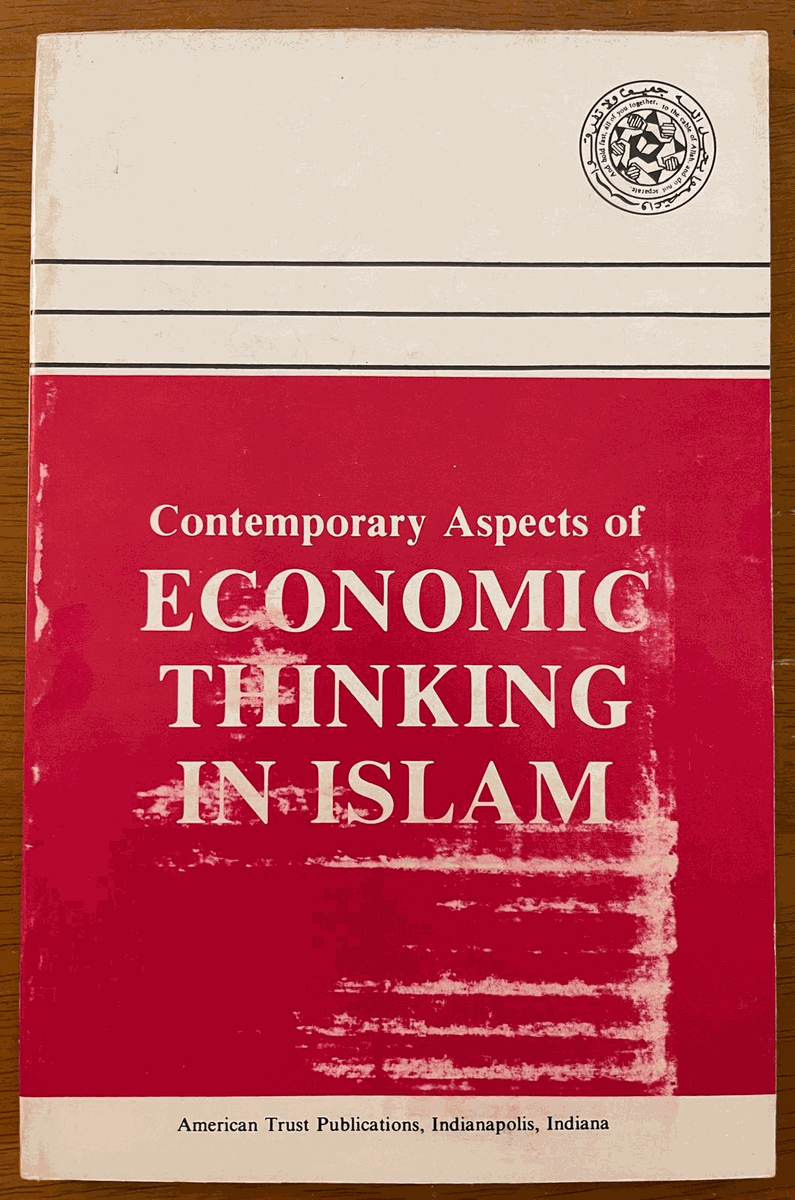
Contemporary Aspects of Economic Thinking in Islam : Proceedings of the 3rd East Coast Regional Conference of the Muslim Students' Assocation of the United States and Canada April 1968
Description
ISBN: 0892590033
Author: Multiple Authors
Publisher: American Trust Publications, Indianapolis, Indiana (1976)
Pages: 116 Binding: Paperback
Description from the publisher:
Introduction:
The Muslim Students� Association of the United States and Canada meeting in Columbus, Ohio, in the fall of the year 1976 resolved to devote each of its four annual regional conferences to an exclusive investigation of a single aspect of the Islamic system. In pursuance of this decision the east coast regional conference held in Holiday Hills, Pawling, New Jersey from April 12 to 14, 1968 selected for its theme the economic system of Islam. The following is a selected presentation of its proceedings.The program of the conference was a fairly comprehensive one, but due to lack of time and of available speakers some significant aspects of it could not be implemented. It would be appropriate therefore to state here in brief what was originally planned.As originally conceived the first part of the discussion was to center on the theme, “The Place of Economics in Islam.� The main focus of this discussion was economic activity viewed in the context of the other concerns of Islam. This was to be appendixes by a classified presentation of relevant verses from the Qur'an and selections from the Hadith literature on the subject. In this way it was hoped that prior to entering into the details of specific issues and practices, participants in the conference would be reminded of the basic sources on which Muslim economic thought is based and which provide the framework within which future thinking is to proceed if it is to conform to the spirit of Islam.The second part of the discussion was to be concerned with the bare statement of the problem, i.e., what are those obvious and incontrovertible areas of contemporary Muslim economic practice which conflict with the specific intent of the sources reviewed in the first part of the discussion.Part three of the discussion was conceived of as the most crucial. Here the idea of a model was to be introduced. Given the injunctions of Islam relative to economic life (part ?), and a statement of departure from these in current practice (part ?), what approach or approaches should be adopted in seeking to bridge the gap between theory and practice, between the intent of Islam and contemporary economic practice.In any attempt at such resolution the record of similarly motivated earlier attempts is likely to prove quite instructive. Hence part four of the discussion was to be comprised of historical surveys of major economic polices from the era of the Holy Prophet and the Rashidun Caliphs through the times of the Umawis and Abbasis to the Ottoman periods. Equal attention was to be focused on outstanding individual contributions to the development of Muslim economic thought through the centuries.